Extracurriculars for Pre-Meds in Hawaiʻi
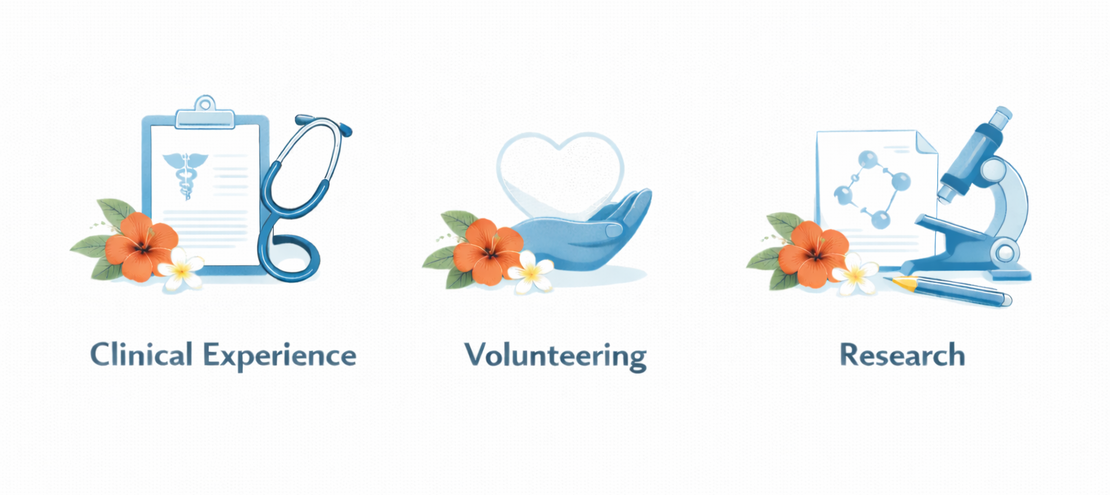
Table of Contents
Pre-med students in Hawaiʻi must build competitive medical school applications through sustained involvement in key extracurricular areas. Clinical experience, physician shadowing, community service, research, and leadership development are essential components evaluated by admissions committees. For students on Kauaʻi and other neighbor islands, accessing these opportunities requires early planning and intentional engagement. This guide outlines recommended hour ranges, strategic considerations, and how to choose experiences that align with long-term goals in medicine. When pursued consistently and reflected on thoughtfully, extracurricular involvement strengthens both applications and professional development.
Extracurriculars for Medical School
To be a competitive medical school applicant, students must demonstrate sustained involvement across five core areas: clinical experience, physician shadowing, community service, research, and leadership. The hour ranges below are guidelines, not strict requirements, and should always be viewed in context.
For information on where to find extracurricular experiences on Kauaʻi, visit Kauaʻi Resources.
Clinical Experience
Typical target: 150–300+ hours
Clinical experience is one of the most important components of a strong medical school application. These experiences often become the strongest talking points during interviews.
Clinical work provides insight into what working in healthcare is truly like.
When pursued consistently over time, clinical experience contributes significantly to emotional and professional development. Students begin to understand:
- The challenges patients face beyond their diagnoses
- How illness affects families and communities
- How healthcare professionals respond under pressure
- The balance between science and the human side of medicine
Over time, it becomes clear that while medicine is grounded in science, the human component is equally essential.
Reading reflective works written by physicians can help contextualize clinical exposure. These books provide insight into how physicians think, reflect, and make decisions — which is particularly helpful for interviews. Two recommended titles:
- When Breath Becomes Air, by Paul Kalanithi
- Complications, by Atul Gawande
Throughout clinical experiences:
- Ask thoughtful questions
- Document observations
- Reflect consistently
Keeping organized notes makes it easier to reference specific patient interactions when writing personal statements and preparing for interviews.
See the Kauaʻi Resources page for clinical opportunities available on the island.
Physician Shadowing
Typical target: 60–100 hours
Shadowing allows direct observation of physicians and provides insight into various specialties.
Shadowing can become repetitive over time, as there is a limit to what can be learned from observation alone. Shadowing the same physician 3–5 times for 5–8 hours each is typically sufficient to gain a realistic understanding of a specialty.
Shadowing also provides an opportunity to build professional relationships. Students should:
- Ask about the physician’s career path
- Learn what they enjoy and find challenging
- Inquire about research or clinical opportunities
- Observe lifestyle and decision-making patterns
Sustained relationships with physicians may later support strong letters of recommendation.
Shadowing across multiple specialties is recommended. Broad exposure helps clarify interests and strengthens application essays and interviews.
As with clinical experience, consistent reflection and documentation are essential for future application preparation.
See the Kauaʻi Resources page for shadowing opportunities available on the island.
Community Service & Volunteering
Typical target: 150–300+ hours
Community service is broad, which can make selecting meaningful involvement challenging.
Volunteering that feels forced or purely transactional often appears inauthentic in applications and interviews. Admissions committees can clearly distinguish between:
- Meaningful involvement
- Box-checking
Volunteer experiences should align with personal values and genuine interests. Engagement driven by authentic commitment leads to stronger growth and more compelling applications.
Examples of meaningful involvement may include:
- Tutoring and mentorship
- Service to elderly populations
- Hands-on community improvement projects
- Educational or technological initiatives
When service aligns with genuine interests, enthusiasm becomes evident — and impact deepens.
Research
Typical target: 300–600+ hours (Optional)
Research is not strictly required for medical school, but it can significantly strengthen an application.
Research develops essential skills for medical training, including:
- Analytical thinking
- Data interpretation
- Problem-solving
- Comfort with uncertainty
- Intellectual curiosity
It also builds professional relationships with faculty mentors and can lead to:
- Presentations
- Publications
- Strong letters of recommendation
For students interested in academic medicine or competitive specialties, research can be a valuable addition.
Leadership
Typical target: 150–300+ hours
Leadership takes many forms.
Some students pursue formal titles such as:
- Student body president
- Club officer
- Organization ambassador
- Executive board member
Others demonstrate leadership through consistent initiative within their roles.
Leadership does not require a title. It often involves:
- Recognizing a need
- Stepping forward
- Guiding a group toward a shared goal
Opportunities to lead exist in nearly every setting. Leadership may include:
- Mentoring peers
- Improving systems or processes
- Organizing teams
- Taking responsibility during challenges
- Supporting collective success
Physicians are required to lead both patients and healthcare teams. For this reason, leadership is an essential skill to develop early. The book Lead, Care, Develop, by Terry Cook is a valuable resource for understanding what effective leadership looks like and how to lead with integrity, service, and responsibility.
Key Takeaways
Extracurriculars are not only required for medical school applications, but they are also some of the best ways to build strong talking points for essays and interviews. These experiences help you develop the emotional, interpersonal, and human side of medicine that cannot be learned in the classroom.
Hours matter because time allows for growth, reflection, and deeper understanding. Long-term involvement helps you move beyond surface-level exposure and truly understand patients, teamwork, leadership, and service.
Choosing experiences you genuinely care about is essential. When you are interested in what you are doing, that enthusiasm is reflected naturally in your application and interviews. Admissions committees can easily tell the difference between meaningful involvement and box-checking.
Finally, the value of extracurriculars comes from reflection. Asking questions, taking notes, and thinking intentionally about what you are learning, doing this will allow you to clearly articulate your motivations for medicine and the kind of physician you hope to become.
When chosen intentionally, extracurriculars do far more than strengthen an application — they shape future physicians.