Table of Contents
Understanding the Medical School Timeline for Pre-Meds in Hawaiʻi
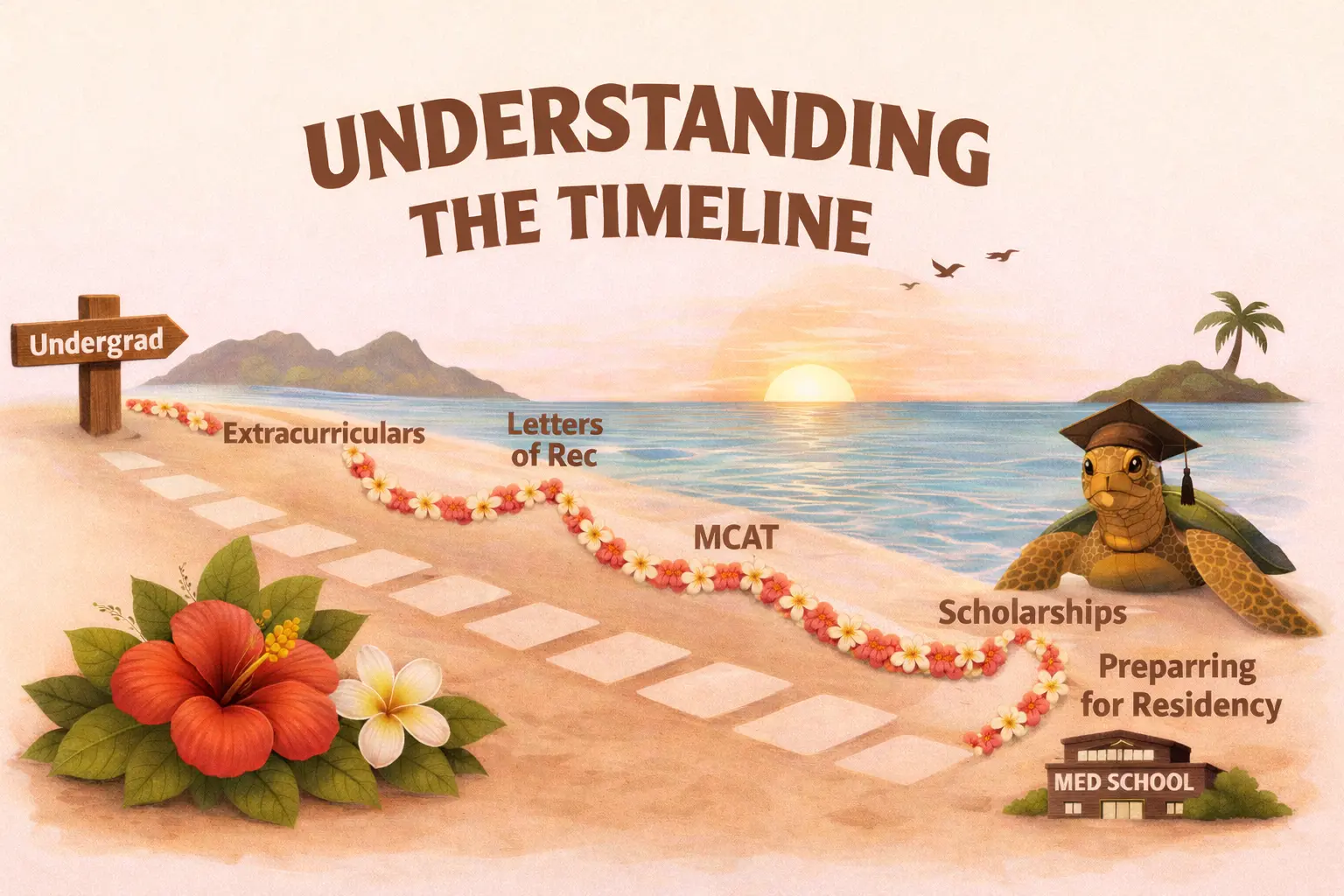
The path to medical school in Hawaiʻi follows a defined sequence: undergraduate preparation, MCAT completion, application cycle, medical school, The Match, and residency training. Students may follow either a traditional or non-traditional timeline, each with distinct advantages and planning considerations. For pre-med students from Kauaʻi and the neighbor islands, early awareness of this full timeline is essential to navigate logistical and financial realities unique to the islands. This guide provides a step-by-step overview to help Hawaiʻi students prepare strategically from undergraduate years through residency.
Traditional Path
Traditional students typically:
- Complete their bachelor’s degree in four years
- Take the MCAT during junior or senior year
- Apply during senior year
- Enter medical school immediately after graduation
They move through medical school, The Match, and residency in a continuous timeline.
Non-Traditional Path
Non-traditional students may take one or more gap years after undergrad to strengthen their application through:
- Work experience
- Research
- Clinical exposure
- Additional coursework
- Career exploration
Although this extends the timeline, it can:
- Improve competitiveness
- Provide valuable experience
- Allow more focused MCAT preparation
- Strengthen financial and personal readiness
Both pathways ultimately lead to medical school, The Match, and residency. However, non-traditional students often require additional planning and financial considerations due to the extended timeline.
Timeline Overview
- Years 1–4
- Year 5 (Optional)
- Years 5–6
- Years 6–10
- Year 10
- Years 11–18
Undergraduate Degree
The student completes their undergraduate degree while building a strong academic foundation.
During this time they should:
- Gain clinical experiance
- Participate in research
- Develop leadership experience
- Volunteer
- Shadow Doctors
While a science degree is not required, most medical schools require:
- A bachelor’s degree
- Specific prerequisite coursework (which varies slightly by school)
Gap Year (Optional)
The student prepares for and takes the MCAT, a critical step in the medical school application process.
If taking a gap year, this time may be used to:
- Strengthen research involvement
- Increase shadowing hours
- Gain clinical hours
- Improve leadership roles
- Prepare thoroughly for the MCAT
Warning
If not taking a gap year, all preparation must be completed during undergraduate studies.
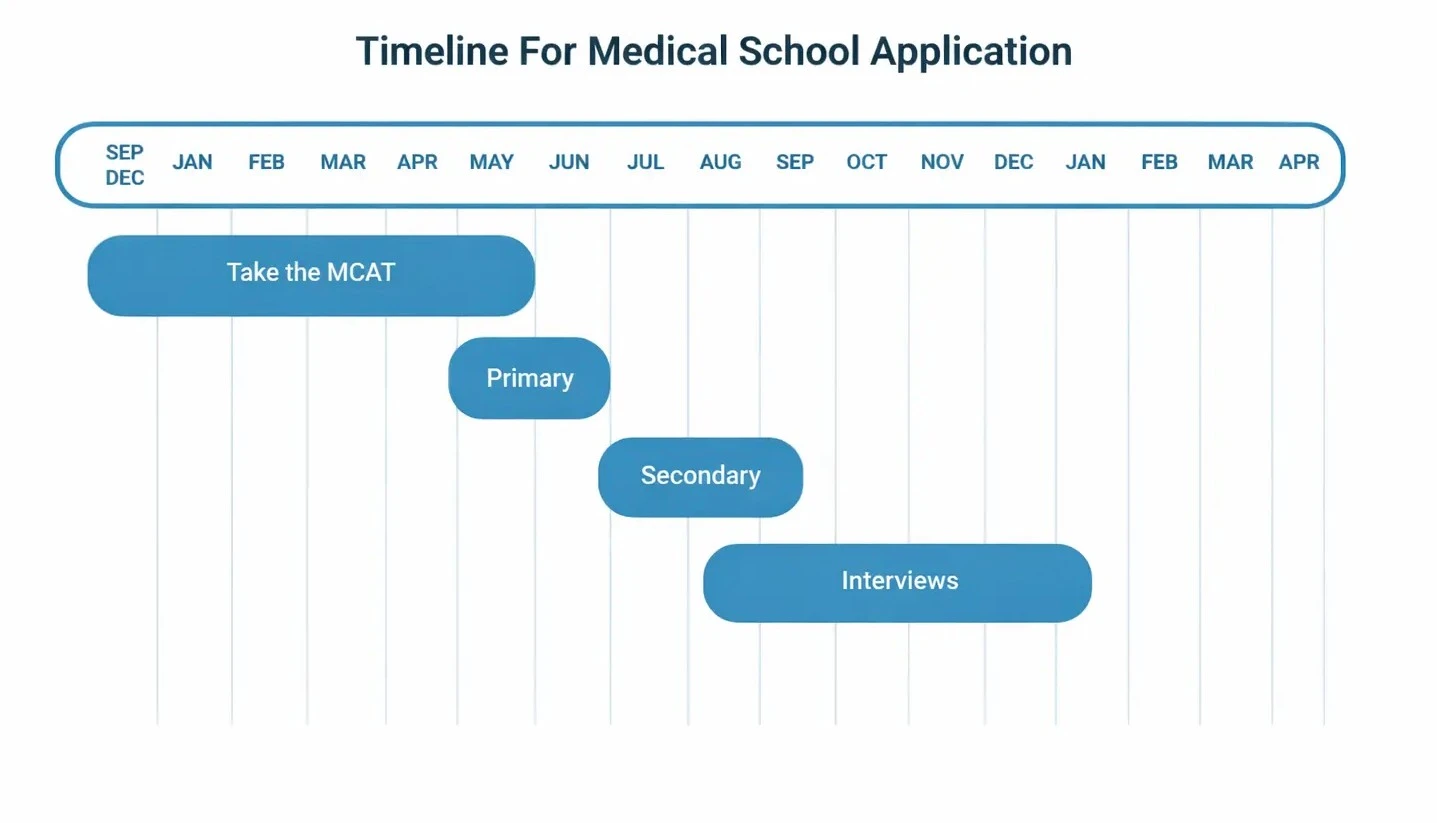
Applying to Medical School
This period includes:
- Securing letters of recommendation
- Submitting primary applications
- Completing secondary applications
- Preparing for interviews
Note
This timeline reflects the recommended schedule to maximize your chances of acceptance. Most medical schools use a rolling admissions process, meaning applications are reviewed as they are received. Submitting earlier significantly increases your chances of securing interviews and acceptance.
However, many students do submit applications later then this it is just not reccemended and can lower your chances of acceptance.
Medical School
The student begins medical school, focusing on:
- Foundational coursework
- Clinical rotations
- Research opportunities
- Hands-on patient care
This phase builds the medical knowledge and clinical skills required for residency.
Warning
Keep in mind that different medical specialties require varying levels of preparation during medical school. In general, primary care fields are typically less competitive to match into, whereas specialties and subspecialties can be significantly more competitive. Dermatology, orthopedic surgery, neurosurgery, and plastic surgery are widely considered among the most competitive and difficult specialties to match into.
Medical Match
During the final year of medical school, the student participates in The Match, which determines residency placement.
Success requires:
- Research in the chosen specialty
- Strong clinical performance
- Competitive board exam scores
- USMLE Step 1 & Step 2 (MD students)
- COMLEX (DO students)
- Strong letters of recommendation
This milestone represents the culmination of years of focused effort.
Residency Training
Residency typically lasts 3–8 years, depending on medical specialty.
During this period:
- You are paid
- You are no longer a student
- You are not yet a fully independent attending physician
- You gain increasing responsibility in patient care